Go Install Primer Tutorial (try twirling round bottom of image for a synopsis ... 'do the twirl now')
Go (by Google) gave me that feeling like you are just seeing the tip of the iceberg, again. A friend kindly put me onto this as a programming language which is an alternative to OOP but not just a function call type of language.
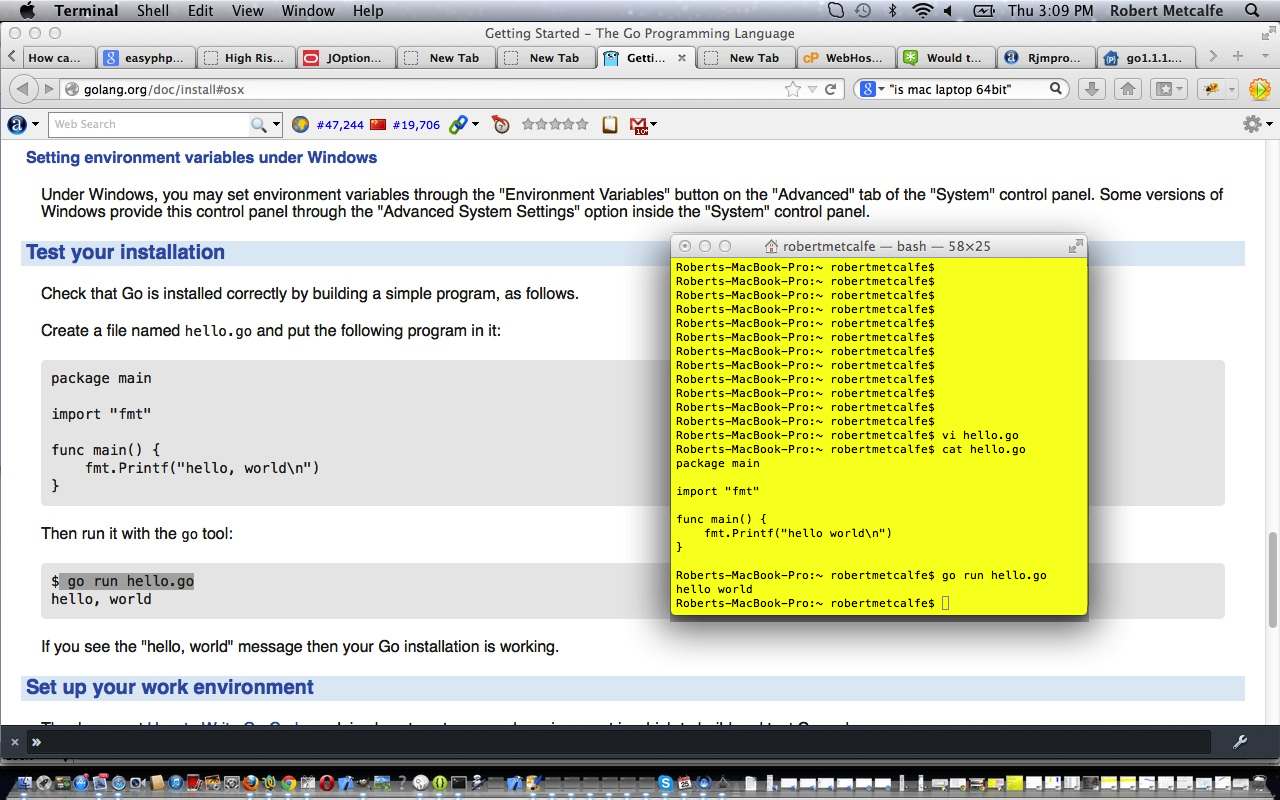
Here we just install it (on a Mac 64bit laptop with Mac OS X 10.7.5) and do the old “Hello World“, but we will explore more in tutorials to come, and in any case here we do 4 x “hello world” with 3 different programs. Meanwhile, have a read from Wikipedia about it, below:
Go, otherwise known as Golang, is an open source, compiled, garbage-collected, concurrent system programming language. It was first designed and developed at Google Inc.[7] beginning in September 2007 by Robert Griesemer, Rob Pike, and Ken Thompson.[3]
The language was officially announced in November 2009 and is now used in some of Google’s production systems.[8] Go’s “gc” compiler targets the Linux, Mac OS X, FreeBSD, OpenBSD, Plan 9, and Microsoft Windows operating systems and the i386, amd64, and ARM processor architectures.[9]
You can download go (2009) programming source codes and rename to hello.go, helloworld.go, slice.go.
Link to Go “spiritual home” at Google.
Link to really good Go tutorials at Google.
Link to Go 1.1 Google Open Source Blog is here.
If this was interesting you may be interested in this too.




Naming the things in a bathroom is a smarter vocabulary exercise than it first looks, because every learner already knows the room, so the words attach to objects they can see and touch instead of floating on a flashcard. Asking how many things can you name turns it into a game rather than a test, and the counting itself becomes the motivation: one more word than last time is a visible win. I like the way this kind of lesson uses a photograph as the prompt, since a picture gives every student the same starting point regardless of level, and the stronger students can move on to describing what each thing is for while beginners are still collecting nouns. The bathroom is a good choice of room too, because it is full of everyday words that textbooks often skip, the small objects people actually say out loud every morning. A daily habit of naming five new things around the house would build a working vocabulary faster than memorising lists, and this post is a good template for it.